







A Newborn Journey
Built on Trust
Expert guidance from your baby's very first day
From the delivery room to that very first checkup, PediaTrust pairs board-certified pediatric expertise with the unhurried, personal support new families are longing for, grounded in the recommendations of the American Academy of Pediatrics and its Illinois Chapter.





What your newborn care includes
Guidance on safe sleep, feeding & soothing
Newborn screening review & follow-up
Jaundice, weight & feeding checks
A same-week visit after you leave the hospital
A pediatrician who answers when you worry
1-3
Days
First visit after discharge (or by 3-5 days of life)
40+
Conditions caught by
Illinois newborn screening
100%
Board-certified
pediatric team
24/7
Nurse line for the
questions that can't wait
Care that follows the evidence and
follows your instincts
Every recommendation below reflects current American Academy of Pediatrics (AAP) guidance. We translate the clinical playbook into calm, real-world steps you can actually use at 3 a.m.

Safe Sleep, Every Sleep
The AAP is clear and consistent: babies rest safest alone, on their back, on a firm, flat surface, free of pillows, bumpers, and loose blankets.¹ We'll provide guidance on safe sleep practices, room-sharing during the first six months, and healthy bedtime routines that support your baby's development and your family's wellbeing.

Feeding With Confidence
Whether you're breastfeeding, formula-feeding, or finding a blend that fits your life, we support your choice without judgment. The AAP encourages exclusive breastfeeding for about the first six months where possible, with continued breastfeeding alongside solid foods to age two or beyond², and we make sure every feeding plan keeps your baby growing and you feeling steady.

Screening & Protection
Important screening and preventative care, including eye ointment,³ newborn blood screening, hearing and heart screening⁵, vitamin K⁴, and the birth dose of the hepatitis B vaccine⁴ will be discussed so you understand how each supports your baby's health and development. We review every result with you and explain exactly what each one means.
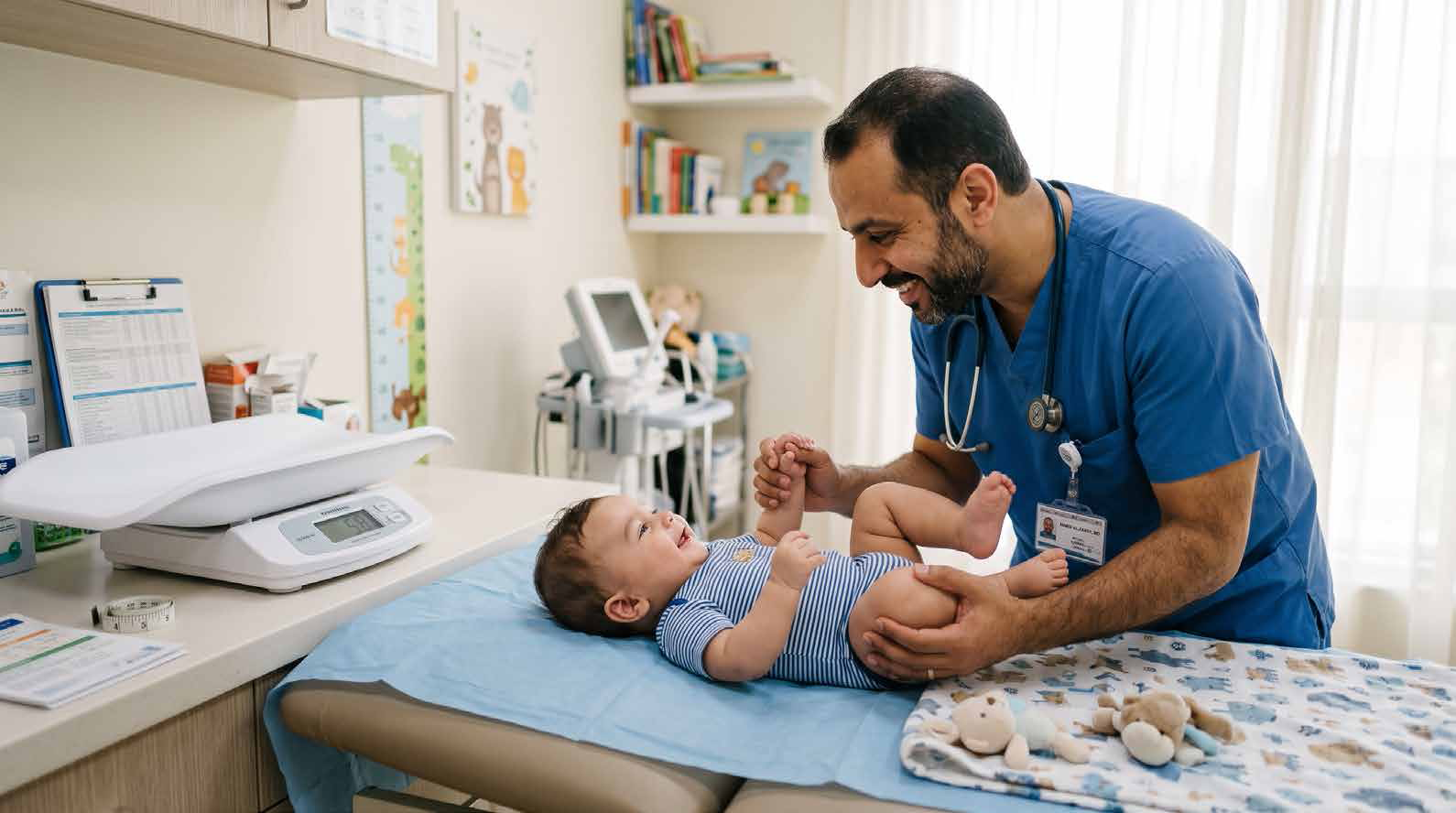
Watching Jaundice & Weight
A little yellow tint and some early weight loss are common, but they deserve a trained eye. We monitor bilirubin, track feeding and weight gain, and know precisely when a watchful pause becomes a reason to act, following the AAP's hyperbilirubinemia guideline.⁷

Skin-to-Skin & Bonding
Those first quiet hours are more than tender, they help regulate your baby's temperature, heartbeat and feeding. We protect time for immediate skin-to-skin contact and gentle bonding from the very start.³

Someone to Call
Trust is built when a real person picks up. Our nurse line and pediatricians are here for the fever you're unsure about, the feeding that isn't working, and the "is this normal?" moments that don't keep office hours.
This is paragraph text. Click it or hit the Manage Text button to change the font, color, size, format, and more. To set up site-wide paragraph and title styles, go to Site Theme.
A roadmap for the days no one fully prepares you for
The AAP recommends that newborns be seen within 1 to 3 days after hospital discharge, or by 3 to 5 days of life. Earlier follow-up may be recommended when closer monitoring of feeding, weight gain, or jaundice is needed.⁶ This roadmap reflects routin well-baby care, while follow-up after discharge and any additional office evaluations are tailored to your baby's individual needs. Here's how those first appointments unfold at PediaTrust, so nothing feels like a surprise.
You'll never leave a visit with a checklist you don't understand. That's the difference between information and trust.
1
Before you go home
Screening panel, hearing test and heart (pulse-ox) check are completed at the hospital; we receive the results.⁵
2
Day 3-5: First office visit
Weight, jaundice and feeding check, plus your first real conversation with your pediatrician.⁷
3
Weeks 1-2: Settling in
Confirming steady weight gain, discussing safe sleep practices, and answering the questions that surfaced at home.
4
Month 1 & beyond: Well-child rhythm
Growth, development and immunizations on the recommended AAP schedule, always at your pace.⁶
"We don't just check boxes on a guideline. We sit with you until the worry lifts. That's what the word Trust in our name is really for."
— The PediaTrust Care Team
Small tests, life-changing answers
Following the Illinois Chapter of the AAP (ICAAP), we treat newborn screening as one of the most important gifts of the first days, a chance to find serious, treatable conditions long before any symptom appears.⁵
The Blood Spot
A few drops from a heel stick screen for over 40 metabolic and genetic conditions in Illinois, a program that has grown steadily since it began with PKU testing in 1965.⁵
The Hearing Test
Added to Illinois screening in 2002, this quick, painless check helps identify hearing differences early, when support makes the biggest difference for language and connection.⁵
The Heart Screen
Since 2013, a simple pulse-oximetry check screens every Illinois newborn for critical congenital heart disease before discharge, catching serious conditions in babies who look perfectly well.⁵
The questions new parents actually ask
How soon after we leave the hospital should we come in?
The AAP recommends seeing your newborn within 1 to 3 days after discharge, or by 3 to 5 days of life.⁶ If your baby left the hospital early, is feeding slowly, or showed signs of jaundice, we'll bring you in sooner. When you book, just tell us your discharge date and we'll find the right window.
What's the safest way for my baby to sleep?
Alone, on the back, on a firm and flat surface such as a crib or bassinet, with nothing soft in the sleep space, no pillows, bumpers, blankets or stuffed toys. The AAP also recommends sharing your room (but not your bed) for at least the first six months.¹ We'll walk through your exact setup at the first visit.
Is a little yellow skin something to worry about?
Newborn jaundice is common and usually mild, but it should always be evaluated. We check your baby's bilirubin and feeding, and we know when the pattern calls for treatment versus simple monitoring, in line with the AAP's 2002 hyperbilirubinemia guideline.⁷ Never hesitate to call if the yellow tint deepens or your baby seems unusually sleepy or hard to feed.
Do we still need screening if the baby looks completely healthy?
Yes, that's the whole point. Many of the 40-plus conditions Illinois screens for cause no visible symptoms at birth. Early detection is what allows treatment to begin before harm is done, which is exactly why ICAAP places such emphasis on completing every part of the screen.⁵
What if we're struggling with feeding?
Feeding rarely goes perfectly from day one, and that is normal. Whether it's latch trouble, low supply worries, or deciding on formula, your pediatrician will help you build a feeding plan that protects both your baby's growth and your wellbeing, and connect you with a lactation consultant when specialized support is needed, with no judgment about how you feed.²
Begin with a
team you can trust
Choosing a pediatrician before your baby arrives is one of the calmest decisions you'll make. Meet us for a prenatal visit, or schedule that all-important first newborn appointment today.

This is paragraph text. Click it or hit the Manage Text button to change the font, color, size, format, and more. To set up site-wide paragraph and title styles, go to Site Theme.
References
Every clinical statement on this page is drawn, in our own words, from the current guidance of the American Academy of Pediatrics (AAP) and its Illinois Chapter (ICAAP).
Sources are numbered to match the markers above.
1
American Academy of Pediatrics. (2025). How to keep your sleeping baby safe: AAP policy explained healthychildren.org/English/ages-stages/baby/sleep/Pages/a-parents-guide-to-safe-sleep.aspx
2
Meek, J. Y., Noble, L., & SECTION ON BREASTFEEDING. (2002). Policy statement: Breastfeeding and the use of human milk. Pediatrics, 150(1), e2022057988. publications.aap.org/pediatrics/article/150/1/e2022057988
3
American Academy of Pediatrics. (2022). Delivery and care of the newborn. First 1,000 Days Knowledge Center. publications.aap.org/first1000days/pages/delivery-and-care
4
American Academy of Pediatrics. (2026). Why your newborn needs a vitamin K shot healthychildren.org/English/ages-stages/prenatal/delivery-beyond/Pages/Where-We-Stand-Administration-of-Vitamin-K.aspx
5
Illinois Chapter, American Academy of Pediatrics. (n.d.) Newborn screening. Details the Illinois program: 40+ screened conditions, PKU testing since 1965, hearing added 2002, and critical congenital heart disease (pulse-oximetry) added 2013. illinoisaap.org/newbornscreening
6
American Academy of Pediatrics. (2025). Recommendations for preventative pediatric health care (Periodicity Schedule). downloads.aap.org/AAP/PDF/periodicity_schedule.pdf
7
American Academy of Pediatrics. (2022). Clinical practice guideline revision: Management of hyperbilirubinemia in the newborn infant 35 or more weeks of gestation. Pediatrics, 150(3), e2022058859.
This page shares general educational guidance and reflects recommendations from the American Academy of Pediatrics and its Illinois Chapter (ICAAP). It is not a substitute for personalized medical advice. Always talk with your pediatrician about your own baby's needs.